
Creativity isn’t treated as a useful skill anymore.
Earlier this week, a friend of mine who teaches art to young children told me something that stuck with me. She said many of her students are struggling to come up with ideas for their assignments. Not the execution—the ideas.
Once they’re given a theme, they do just fine. But when faced with a blank page, they don’t know where to begin.
They can follow instructions. They can replicate. But when asked to imagine something original, they can’t.
When Creativity Becomes Optional
In a lot of school systems today, creativity is treated as secondary. The focus is on measurable outcomes: math scores, reading levels, standardized testing. Creative classes like art and music become an afterthought, and kids have picked up on that.
If something isn’t reinforced, they stop seeing the value in it. And over time, they stop engaging with it altogether.
But the ability to generate ideas, think creatively, solve problems and approach things from new angles, shouldn’t be treated as optional. It should be something foundational, especially for kids.

At the same time, the way kids spend their time has fundamentally shifted.
More screens. More passive consumption. Faster content. Constant stimulation.
A LOT less boredom. And that’s also a problem.
Boredom is where creativity often begins. It’s where kids are forced to make something out of nothing. To invent games, tell stories, build, draw, explore.
When I was a kid, we were either outside all the time or indoors playing imaginative games. A cardboard box could become a spaceship. Dolls turned into café guests. Nothing was made for us, which meant everything had to be created.
Now, younger kids are on iPads instead of playing outside, older kids are scrolling endlessly, and middle and high schoolers are turning to AI for ideas. At every stage, we’re replacing thinking with technology.

The ADHD Conversation
There’s also a broader conversation happening around Attention-Deficit/Hyperactivity Disorder. About 20 years ago, roughly 6% of children in the U.S. had been diagnosed with ADHD. Today, that number is closer to 10-11%, according to the Centers for Disease Control and Prevention.
So, I’m wondering…
How much of what we’re seeing is purely neurological, and how much is environmental?
Attention isn’t fixed. It’s a skill that develops over time, built through activities that require patience, repetition and sustained engagement.
I see this in my own life. I play the violin (fun fact). If I go a few days without practicing, it becomes noticeably harder to get back into it. Not because I’ve forgotten how to play, but because I’ve fallen out of the habit of concentrating.
The ability to sit with something difficult for an extended period of time is a skill in itself, and one that requires consistent development.

For kids, that same skill is developed through things like drawing, writing, building, practicing, or working through something without an immediate reward.
When those experiences are replaced with fast, high-reward digital inputs, the brain adapts. It starts to expect constant stimulation—something research is increasingly pointing to, with studies like this one from the International Journal of Medical and Pharmaceutical Research linking heavy screen use to shorter attention spans and reduced ability to focus on complex tasks.
Focus becomes harder and frustration tolerance drops. That doesn’t negate ADHD. But it does suggest that the environment many kids are growing up in may be working against the development of focus and creativity at the same time.
Where Aware Juniors Comes In
This is one of the reasons why why we created Aware Juniors. To help parents and children go back to basics.
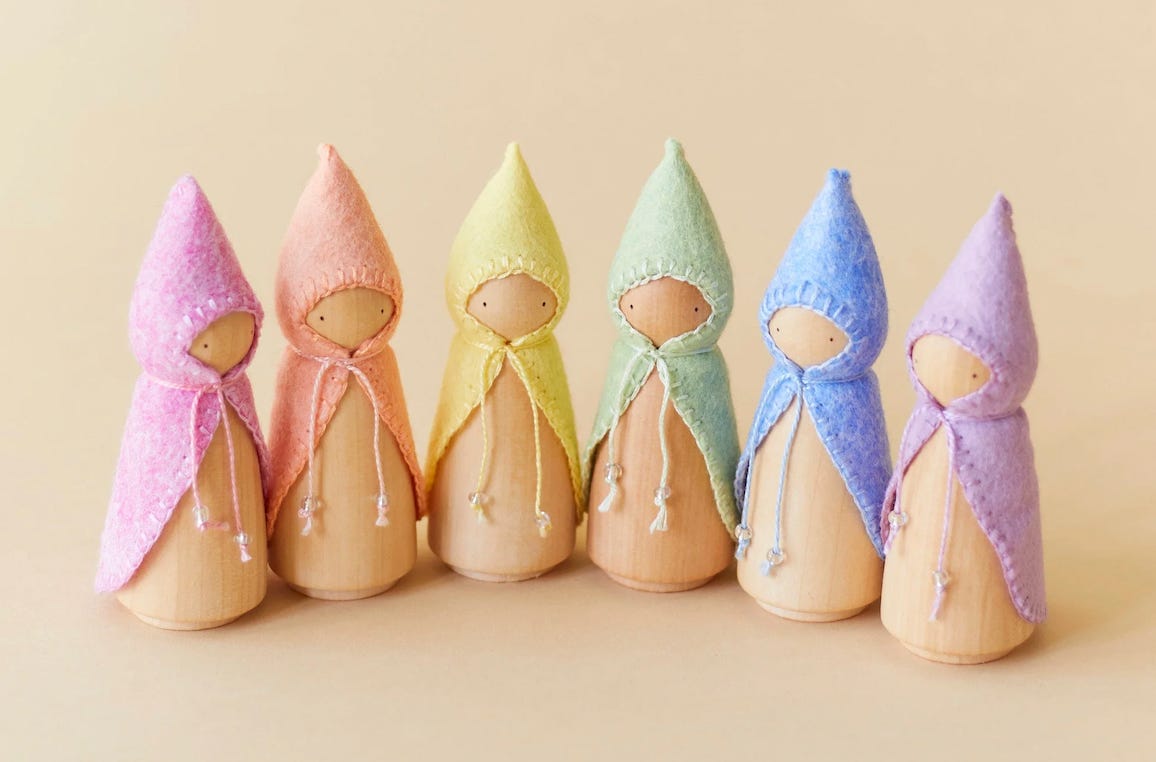
Our collection of kids toys is designed to be fun and engaging without being overwhelming. Each piece is handmade from natural materials like wood, cotton and wool, and designed to invite interaction and creativity. High-quality pieces that can even be passed down to future siblings (or grandchildren)!
Our goal isn’t to entertain children nonstop. It’s to give them the space and tools to play, imagine and think for themselves.
Stay tuned for more handmade, made in the USA kids toys coming soon, including puzzles, finger puppets and more!


